Browsed by
Tag: Health

Appreciating what you have

Appreciating what you have

appreciating-what-you-haveWhile its important to continue improve upon yourself, it is also important to take some time out to just be happy with your current situation. Its easy to get lost in the constant struggle to get to the next big thing. The trouble is that there are almost always going to be some things that could be better. You could spend your while life worrying about what you don’t have, without ever fully appreciating what you do have.

Realize what you have
Its not always easy to appreciate what you have simply because you don’t realize you have it. There are a lot of things you probably have that you might take for granted every day. Even if you don’t think much of something, it could be a lot more than many other people have(or ever will for that matter).

Just the fact that your able to read this article means that you most likely have internet access, which by itself is a big thing to be appreciative of. Here is a list of a few categories which might help you come up with some things you have to be appreciative for:

Heath
Family
Friends
Hobbies
Interests
Possessions

These categories are meant to be very basic and broad ranging. You can find specific things to appreciate by expanding upon them. All you need to do is find a category in which you have a lot of things to appreciative, and think of some things within that category. For example, if you have a large or close family you could think of the family members which mean the most to you. You can also think of some of the things they have recently done for you. These categories just to help get you started, if they don’t quite work out, you can always make up your own.

The main point is that if you don’t take the time to just sit back and enjoy what you have, then you are missing out. You probably had to work quite hard to be very lucky to have some of things you have in your life. Why not take the time to really enjoy the fact that you have them?

Take Your Vitamins

Take Your Vitamins

take-your-vitaminsNobody is happy when they’re sick. It seems like no matter how much you try, sometimes you still inevitably get sick. However there’s things you can do to help prevent yourself from getting sick, or at least from getting sick enough to have it interfere with your life.
Taking the right vitamins and herbal supplements can have a very positive effect on your health. They are available at just about every store, but the problem is that there are so many different kinds that trying to find the right ones can be overwhelming.

To make it easier to work your way through the maze of vitamins, here is a list of common health problems, and the vitamins and supplements you can take to help these conditions:

Upset Stomach-

Acidophilus/Probiotics (If you have problems with dairy, make sure to get ones without milk proteins, or this could complicate rather than help your condition)

Ginger Tea/Juice/Root/Pills
(If plain ginger is too strong for your taste, I would highly recommend lemon ginger tea. It tastes like hot lemon cake!)

Detox Tea (Mostly for use when you have been eating a lot of junk, or have been feeling ill for several days and anything else you have tried to combat your stomach problems has failed. *WARNING* It do not take for more than recommended, as this can cause you to become more sick, and possibly develop other problems.)

Headache/Runny Nose/Cough/General Cold Symptoms-
Echinacea Tea/Pills (This is probably one of the single greatest supplements I have come across! I swear by this stuff during cold and flu season. I also believe it is probably the reason I hardly ever cough, and haven’t gotten fully sick in quite some time)

Vitamin C Packets (Available in a wide variety of flavors. Vitamin packets are also available in formulas to help everything from heart health to sore joints.)

Sore Joints/Chronic Joint Pain/Muscle Aches-

Calcium/Magnesium Supplements – This is sometimes recommended for women help prevent osteoporosis-weakening and eventually fracturing of bones with age.

Glucosamine Chondroitin Juice/Pills – This can be beneficial for muscle/joint pain.

These vitamins and supplements are just a starting point, and can be safe to take everyday to help improve your overall health. However, if you are having these problems regularly, and you have not seen a doctor about it, you probably should. Some of these mild problems could be early indicators of a more serious condition.

Food Journaling

Food Journaling

Its easy to read random news stories about the latest health foods and find differing opinions on the same subject. One week you read about how you shouldn’t drink coffee because of how bad the caffeine in it is, then the next week you read about its great antioxidant properties. How do you know which answer is right? Or better yet, how do you know which answer is right for you? Maybe your extra sensitive to caffeine. Or maybe it doesn’t bother you much, and you would be benefited by the antioxidants.

One way to sort of test the waters with new ideas for what to eat is to keep a food journal. In your journal, you can write down what you eat, drink, and any vitamins or herbs that you might ingest during the day.

So what should be on this journal?
You can adjust the details of your journal to fit your personal level of commitment and interests. For example, you may or may not want to include things like amount, calorie count, protein, etc.

The food journal can also include many things that may be related to the foods you eat. For example, you can include your mood on a scale of 1 to 10. Maybe you’ll find that different foods can affect your mood in different ways.

Okay, but what do I use to keep track of this stuff?
Here is what I believe to be an good way to keep an accurate and effective journal.
First, you will need a small notebook, and pen that you can carry around with you. You can use this to write down things you want in your journal as you eat/drink them. This is useful since it can be easy to forget to record something if you don’t do it right away.
Next, you will need some kind of spreadsheet program. There are many free and paid options for this. Open office has a very nice spreadsheet program called Calc. After selecting a spreadsheet program, you will then need to set up your field headings for the various things you want in your journal.

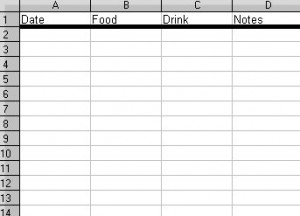
Here are a few example headings you can include to get you started…

food journal sample

This format is assuming you are going to do daily entries and only keep one row of data for each day. If you want, you can use many rows of data for each day.

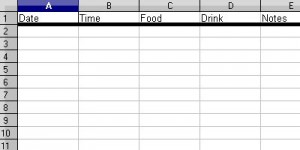
Here is an example of a multiple row per day version of the above example.

foodjournal2

Note that there was only one field added in this example. In this format, you record your details for the date and time specified. You can keep a record for breakfast, lunch, dinner, and snacks by using this format. This way you get more details, but it is also more work. So there is a trade off.

Once you have your fields set up, you can begin recording your journal entries in your notebook, and transferring them to your spreadsheet when it is convenient. Depending on your spreadsheet software, you may eventually be able to make charts and graphs of the fields for easier interpretation.

Although journaling can give you a great amount of information, it is important to keep in mind that you should not necessarily use the results as absolute truth. You may notice a spike in energy or mood on your journal when eating certain foods… but that doesn’t mean that it is good idea to do the things with the highest gains every day. The gains might not even be related to the things you think they are. It could be that the things you ate the day before are related to the advantages. Or it could be that there is no relation at all.