Browsed by
Category: Health

How to Stay With An Exercise Routine
How to Stay With An Exercise Routine

how-to-stay-with-an-exercise-routinePlanning and setting up an exercise routine is fairly easy, and its benefits are well known. The hard part is staying with it. You might initially begin your routine with a really good start, but before you know it your morale begins to decline and eventually your activity level diminishes.

One of the problems is the amount physical work, discipline, commitment and determination that exercising actually requires. In today’s society you might work hard typing away at lightning speed, sending text messages halfway across the country(or world for the ambitious). But all too often words like walk, jog, and run are nothing more than speed settings on a riding lawn mower.

Sure, you might also be used to lifting some weight here or there. Maybe you’ve even occasionally used your awesome strength to impress everyone by pulling a paper jam from a printer. Unfortunately, even the mightiest paper jam can be put to shame by a few simple exercise weights.

So how then does a modern human being stand a chance of establishing an exercise routine in a world where a persons idea of a vigorous workout is having to park at the far end of the parking lot?

Start small…

Though it may not seem like it at first, one of the main hurdles to overcome when beginning an exercise program is the amount of excitement you initially have. You might be jumping for joy at the prospect of a fitter, new you. But be careful not to overdo it. Its incredibly easy to begin a routine with a great amount of enthusiasm and effort, only to find yourself falling behind a week or two later.

When you start big, you eventually begin to get tired of trying to maintain the same drive and determination you had began with. As the initial excitement wears off, it can get harder and harder to maintain the same high level of activity as part of a regular routine. This leads to you loosing motivation, which leads to shorter and less enthusiastic workouts. Eventually this causes you to start skipping out on a few exercises all together. Then before you really even realize what happened, you notice that its been weeks since you’ve last exercised.

This sad sad tale is all too common…

The problem is that you start out too fast and with too much effort. This isn’t a baking contest, and you aren’t really going to find instant gratification. Instead of trying to get a big jump start by pouring all kinds of effort into your first few days, it is important to learn to pace yourself. Start off slowly, and then work your way up from there when you feel really ready. This way you will be able to have longer lasting enthusiasm because its likely that you won’t have such a strong desire to lower your activity level after the initial excitement wears off.

Commitment…
Laziness and procrastination are powerful forces. Establishing a basic plan for an exercise routine is your first line of defense against these forces, as well as your first step towards making a commitment. By setting up some kind of plan, you are saying to yourself “Okay, this is what I am committing myself to.” Having at least a somewhat formal plan helps keep you on track.

You can set your initial exercise plan to say that you will exercise every day, every other day, or even just once a week. Whats important is having a starting point which you know you can stick to. Your initial commitment should be something reasonably easy to start with. That way you will have a base line that you can follow to make sure that you do not get too overwhelmed. You can easily increase your base line if you feel compelled, but it can be devastating to your routine if you need to continuously decrease your minimum. So pick something that you know you can stay with and be careful not to commit yourself to something that is unrealistic. The key is having a minimum that you can commit to follow. Without a solid commitment of some kind, procrastination and laziness can easily invade and wreak havoc on any hopes of establishing a good exercise routine.

Healthy Happiness

Healthy Happiness

healthy-happinessEveryone has had those times where they feel sluggish and tired, but don’t know why. If you are getting plenty of sleep and have a proper diet, there is probably a different problem. You are probably simply not getting enough exercise.

Now you might be thinking you do not have enough time to exercise, but that is not true. Exercise can be done in minutes a day through something as simple as a short walk or even a game such as wii fit. Several months ago I started using wii fit and have found that it can be a great way to exercise.  In case you’ve never heard of it, wii fit is an accessory you can buy for the wii game console.   This is a great way to get kids to exercise too, since to them it is basically jumping around and playing video games. However what they don’t realize is their muscles can be getting a great workout at the same time.

Another simple way to exercise is to go for a walk. (For more on walking as a source of happiness read the article, “Walk it off”) This can be a great way to exercise because it does not really feel as though you are exerting yourself, but it does stretch your muscles and get the blood flowing, which can make you feel much better.

Joining a sports team can also be a great way to exercise. This is fun, and can give your body a great workout. You might be just as tired as you would be from running around the block, but I bet you will have had more fun. Sports teams also have the added social aspect and many times people end up becoming good friends with the people on their teams.

These are just some easy and relatively inexpensive ways to exercise. However if you want to put in the time and money there are many other ways to exercise. You could join a fitness club or go to a gym. Some people even buy gym equipment to use in their own home.

Now how does any of this make you happy? Well, exercising can stretch out your body and make it work better.  This all  can lead to you getting sick less, and being an overall healthier person. As we all know, people are much more happy when they are healthy, than when they are sick. Also exercising can help you burn calories, and lose weight. This can lead to better self esteem, which could make you a more confident person. This could even possibly, maybe even lead you to having a better quality of life.

Take Your Vitamins

Take Your Vitamins

take-your-vitaminsNobody is happy when they’re sick. It seems like no matter how much you try, sometimes you still inevitably get sick. However there’s things you can do to help prevent yourself from getting sick, or at least from getting sick enough to have it interfere with your life.

Taking the right vitamins and herbal supplements can have a very positive effect on your health. They are available at just about every store, but the problem is that there are so many different kinds that trying to find the right ones can be overwhelming.

To make it easier to work your way through the maze of vitamins, here is a list of common health problems, and the vitamins and supplements you can take to help these conditions:

Upset Stomach-

Acidophilus/Probiotics (If you have problems with dairy, make sure to get ones without milk proteins, or this could complicate rather than help your condition)

Ginger Tea/Juice/Root/Pills
(If plain ginger is too strong for your taste, I would highly recommend lemon ginger tea. It tastes like hot lemon cake!)

Detox Tea (Mostly for use when you have been eating a lot of junk, or have been feeling ill for several days and anything else you have tried to combat your stomach problems has failed. *WARNING* It do not take for more than recommended, as this can cause you to become more sick, and possibly develop other problems.)

Headache/Runny Nose/Cough/General Cold Symptoms-
Echinacea Tea/Pills (This is probably one of the single greatest supplements I have come across! I swear by this stuff during cold and flu season. I also believe it is probably the reason I hardly ever cough, and haven’t gotten fully sick in quite some time)

Vitamin C Packets (Available in a wide variety of flavors. Vitamin packets are also available in formulas to help everything from heart health to sore joints.)

Sore Joints/Chronic Joint Pain/Muscle Aches-

Calcium/Magnesium Supplements – This is sometimes recommended for women help prevent osteoporosis-weakening and eventually fracturing of bones with age.

Glucosamine Chondroitin Juice/Pills – This can be beneficial for muscle/joint pain.

These vitamins and supplements are just a starting point, and can be safe to take everyday to help improve your overall health. However, if you are having these problems regularly, and you have not seen a doctor about it, you probably should. Some of these mild problems could be early indicators of a more serious condition.

Food Journaling

Food Journaling

Its easy to read random news stories about the latest health foods and find differing opinions on the same subject. One week you read about how you shouldn’t drink coffee because of how bad the caffeine in it is, then the next week you read about its great antioxidant properties. How do you know which answer is right? Or better yet, how do you know which answer is right for you? Maybe your extra sensitive to caffeine. Or maybe it doesn’t bother you much, and you would be benefited by the antioxidants.

One way to sort of test the waters with new ideas for what to eat is to keep a food journal. In your journal, you can write down what you eat, drink, and any vitamins or herbs that you might ingest during the day.

So what should be on this journal?
You can adjust the details of your journal to fit your personal level of commitment and interests. For example, you may or may not want to include things like amount, calorie count, protein, etc.

The food journal can also include many things that may be related to the foods you eat. For example, you can include your mood on a scale of 1 to 10. Maybe you’ll find that different foods can affect your mood in different ways.

Okay, but what do I use to keep track of this stuff?
Here is what I believe to be an good way to keep an accurate and effective journal.
First, you will need a small notebook, and pen that you can carry around with you. You can use this to write down things you want in your journal as you eat/drink them. This is useful since it can be easy to forget to record something if you don’t do it right away.
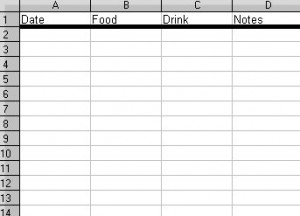
Next, you will need some kind of spreadsheet program. There are many free and paid options for this. Open office has a very nice spreadsheet program called Calc. After selecting a spreadsheet program, you will then need to set up your field headings for the various things you want in your journal.

Here are a few example headings you can include to get you started…

food journal sample

This format is assuming you are going to do daily entries and only keep one row of data for each day. If you want, you can use many rows of data for each day.

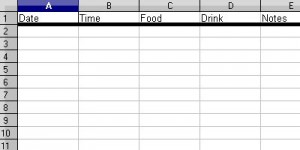
Here is an example of a multiple row per day version of the above example.

foodjournal2

Note that there was only one field added in this example. In this format, you record your details for the date and time specified. You can keep a record for breakfast, lunch, dinner, and snacks by using this format. This way you get more details, but it is also more work. So there is a trade off.

Once you have your fields set up, you can begin recording your journal entries in your notebook, and transferring them to your spreadsheet when it is convenient. Depending on your spreadsheet software, you may eventually be able to make charts and graphs of the fields for easier interpretation.

Although journaling can give you a great amount of information, it is important to keep in mind that you should not necessarily use the results as absolute truth. You may notice a spike in energy or mood on your journal when eating certain foods… but that doesn’t mean that it is good idea to do the things with the highest gains every day. The gains might not even be related to the things you think they are. It could be that the things you ate the day before are related to the advantages. Or it could be that there is no relation at all.

Opinionated Eating

Opinionated Eating

opioninated-eatingThere are many different opinions on what types of food are considered healthy.   The entire topic of health food in itself can be very subjective.  Each person probably has their own idea on what a healthy food actually is.

For example, lets consider a typical sandwich with some sort of meat and cheese.  Depending on who you ask, this may or may not be considered healthy.  Someone may look at the type of bread being used and decide that it does not have enough fiber to be considered healthy, while others may consider bread in general to be a good dietary choice.   The cheese may also lead to some controversy on whether not the particular type is good for you, or even if any type is good for you.    Then there is the meat.  Most of you are probably already at least somewhat aware of the various controversies surrounding meat and its varying types.

There is such a large amount of controversy and debate on just about everything that is edible.  With all this conflicting information, how are you ever supposed to figure out what information is right,  and what isn’t?  One way is to make the decision to stay informed about any current health food information which interests you.

Even if I could give you the single most important food you should eat today according to the most current research, who’s to say that next week some other study wont find that the same food isn’t quite as good as originally thought?  Current research may be able to give you an idea of what our current level of knowledge is on a particular food, but really it is your responsibility to keep yourself informed on the subject because you never know what might change.

On top of reading about the latest research, another great method of finding out what foods are right for you is to listen to your own body and use a bit of common sense.  Sometimes you can tell when a specific type of food does not agree with you.  Finding what does and does not work for you can take time and effort to figure out, but eventually if you put your mind to it, you might be able to get a better picture of what you should be eating.

A good sense of what you should and should not eat can be gained and maintained by applying a combination of common sense, and knowledge you have obtained. If you notice an improvement in yourself, it will reinforce your knowledge with experience. If you notice the opposite, it will also reinforce that new knowledge and give you reason to avoid certain things.  Likewise, if you read up on a particular food and experience consistently good results from wherever you read it, eventually you can get a good list of places you can look for useful information.

Just keep in mind that research and knowledge are a great starting point, but it is also just as important to listen to your body to know if you are really being benefited. What works in a book or web article, may not always work for you.

Healthy Eating at Work

Healthy Eating at Work

For many of us who work at a conventional job, eating a healthy lunch can become quite a difficult task. In order to eat a truly healthy lunch (and not just eat salads every day) you would need to stop eating out almost completely. This means a meal would need to be prepared at home for taking to work every day. Doing this every single work day can become a task which is easily forgotten about as laziness quickly sets in.

Often the last thing you want to do after coming home is to spend the little free time you have making a mid day meal for the next day. Thus, this task can often get left unattended and the cycle of eating quick, cheap and unhealthy food can easily begin.

Listed here are some useful tips on how to break this cycle and keep it broken once and for all. With a good amount of self discipline, you may finally be able to enjoy healthful food at work with as little trouble as possible.


Tip# 1 Prepare what you can on the weekend.

Instead of doing the preparation the morning of, or night before, it is easier and much more efficient to do most or all of the food preparation on the weekend when you actually have the time to do so. This basically saves you from yourself. It helps prevent boredom/stress/laziness of the work week altering your food selection by not giving you the opportunity to go the lazy route during the week and just order quick and unhealthy food.

Even if you only prepare a portion of your meals ahead of time, at the very least you are still giving yourself an extra reason to be motivated. It will be harder to neglect finishing preparation during the work week when you already have half(or more) of the next days afternoon meal prepared. You’ll know that it will be less work, and that it would be a waste of time and effort if you do not use what you had already prepared.


Tip# 2 Buy once, and buy things that will last the week

When you go shopping for your afternoon lunch food for the week, it is useful to buy things that will last the entire week. For example, if you know that you are going to go through an entire bag of carrots in only a few days, get two now instead of having to run out in the middle of the week for more.


Tip #3 Make a list

Make a list of everything you will need before you actually go shopping. This will help ensure that you will not need to run out during the middle of the week for more food(which may tend to motivate you to go for the cheap unhealthy food instead).


Tip# 4 Go for Whole vs Pre-Cut/prepared

There is now a wide variety of food that can be found already pre-prepared for you such as pre-cut pineapple, watermelon, carrots, etc. The advantage of these foods is that you save yourself time by not having to prepare them yourself. The disadvantages can vary widely, but for the most part you may be sacrificing taste, quality, and nutrition, and even money. Pre-prepared foods can be more expensive, contain preserving chemicals, and look artificially fresher than they really are.


Tip# 5 Stay away from packages.

For the most part, you are better off staying away from the packaged items(with a few exceptions). If you are going to buy packaged/frozen dinners, you may as well just be eating out. The point in buying and bringing food with you instead of going out is to get fresh, healthy food (unless your only goal is to save money).