Food Journaling
Its easy to read random news stories about the latest health foods and find differing opinions on the same subject. One week you read about how you shouldn’t drink coffee because of how bad the caffeine in it is, then the next week you read about its great antioxidant properties. How do you know which answer is right? Or better yet, how do you know which answer is right for you? Maybe your extra sensitive to caffeine. Or maybe it doesn’t bother you much, and you would be benefited by the antioxidants.
One way to sort of test the waters with new ideas for what to eat is to keep a food journal. In your journal, you can write down what you eat, drink, and any vitamins or herbs that you might ingest during the day.
So what should be on this journal?
You can adjust the details of your journal to fit your personal level of commitment and interests. For example, you may or may not want to include things like amount, calorie count, protein, etc.
The food journal can also include many things that may be related to the foods you eat. For example, you can include your mood on a scale of 1 to 10. Maybe you’ll find that different foods can affect your mood in different ways.
Okay, but what do I use to keep track of this stuff?
Here is what I believe to be an good way to keep an accurate and effective journal.
First, you will need a small notebook, and pen that you can carry around with you. You can use this to write down things you want in your journal as you eat/drink them. This is useful since it can be easy to forget to record something if you don’t do it right away.
Next, you will need some kind of spreadsheet program. There are many free and paid options for this. Open office has a very nice spreadsheet program called Calc. After selecting a spreadsheet program, you will then need to set up your field headings for the various things you want in your journal.
Here are a few example headings you can include to get you started…
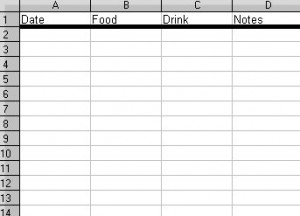
This format is assuming you are going to do daily entries and only keep one row of data for each day. If you want, you can use many rows of data for each day.
Here is an example of a multiple row per day version of the above example.
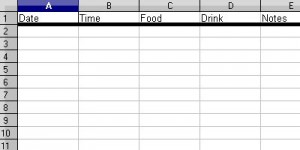
Note that there was only one field added in this example. In this format, you record your details for the date and time specified. You can keep a record for breakfast, lunch, dinner, and snacks by using this format. This way you get more details, but it is also more work. So there is a trade off.
Once you have your fields set up, you can begin recording your journal entries in your notebook, and transferring them to your spreadsheet when it is convenient. Depending on your spreadsheet software, you may eventually be able to make charts and graphs of the fields for easier interpretation.
Although journaling can give you a great amount of information, it is important to keep in mind that you should not necessarily use the results as absolute truth. You may notice a spike in energy or mood on your journal when eating certain foods… but that doesn’t mean that it is good idea to do the things with the highest gains every day. The gains might not even be related to the things you think they are. It could be that the things you ate the day before are related to the advantages. Or it could be that there is no relation at all.